Journal
Studio · Field note
Aug 4, 2026
14 min read
By Top Notchh Team
Reviewed Sep 1, 2026
Sources: externally verified
The catalog-to-campaign gap in Indian D2C
A field guide to turning accurate product data into approved, channel-ready creative without inventing campaign coverage or performance benchmarks.
In brief
- Catalog accuracy and campaign activation are separate operating systems.
- A canonical product packet should connect identifiers, claims, price, availability, assets, and approvals.
- Coverage should be measured from the brand's own live catalog and channels, not an invented benchmark.

\n\nThere is a specific operational problem inside almost every fast-growing Indian D2C brand on Shopify that costs more growth than any single performance-marketing decision, and it is not a decision most founders think of as an operational problem at all. It is the gap between what sits in the product catalog and what is actually running as active creative in the market across every channel the brand serves.
Ask a growth lead at a mid-scale Indian D2C brand — one of the boAt or Mamaearth-shape businesses at their five-to-fifteen-crore-monthly-revenue phase — how many SKUs their catalog contains. They will know. Ask them how many of those SKUs have active Meta ad creative running this week. They will not know. They will guess, and the guess will be wrong by a factor of two or three, and the honest answer will be that most of the catalog is not being marketed at all.
This is the catalog-to-campaign gap. It is invisible in most dashboards. It is the single largest hidden growth lever in modern Indian D2C.
What the gap actually looks like
The typical scaled Indian D2C brand catalog contains between eighty and three hundred SKUs. Some are the brand's flagship products — the two or three items that drive most revenue. Some are variants of the flagship — the same product in different colours, sizes, or flavours. Some are auxiliary products — bundles, gift boxes, seasonal drops, limited editions. Some are new launches, still finding their audience.
The active advertising spend, at any given time, tends to concentrate on the flagship. Twenty percent of the catalog receives eighty percent of the marketing attention. This is not unreasonable — the flagship is what performs. But the shape of that concentration has a specific consequence. The remaining eighty percent of the catalog exists on the site, is listed on Shopify, is warehoused, is inventoried, and is effectively invisible to the market. Customers who visit the storefront find those products only if they were already looking. Nobody discovers them in feed.
This has three specific costs.
The discovery cost is that a customer who would have bought a secondary product had they seen it in an ad never sees it. They see the flagship, they buy the flagship, and the secondary product's addressable market is capped at the intersection of "already visited the site" and "browsed enough to find it." That intersection is small.
The basket cost is that customers who did buy the flagship do not know the auxiliary products exist. Post-purchase upsell can partially fix this, but it fixes it downstream of the moment the customer made their initial purchase decision, when their willingness to spend was highest.
The inventory cost is that the SKUs sitting outside the marketing spotlight often carry inventory that ages. Discontinuation writeoffs, end-of-season markdowns, and dead stock are the visible manifestation. The invisible manifestation is that the founder eventually decides not to launch new secondary products because the previous ones did not perform, without recognising that the previous ones never got the marketing input required to know whether they would have performed.
Each of these is a real cost. The composite, across a year, is often more than the brand's entire performance-marketing budget.

Why the gap exists in the first place
The gap is not an intelligence failure. Founders and growth leads know their secondary catalog is underserved. The gap exists because the operational cost of running creative and campaigns for the full catalog is genuinely high, and the team's capacity — whether in-house or through an agency — is not shaped to close it.
Producing a Meta ad creative for a new product requires: product photography, copy in multiple lengths for different placements, a video or animated version, an offer or angle to test, a landing page or product page ready for the traffic, a UTM structure, an audience setup, a budget allocation, an approval loop with the founder or brand lead, and — critically — a way to know within seventy-two hours whether the creative is working or should be killed.
The team's capacity to do this end-to-end usually caps out at somewhere between six and fifteen active creative sets per week. Almost every mid-scale Indian D2C brand runs at that ceiling. The ceiling is not budget. It is production and approval throughput. Given the ceiling, the team rationally allocates the throughput to the flagship, where the return is most predictable.
The secondary catalog sits behind that ceiling, not because it does not deserve attention, but because the operational cost of paying attention to it exceeds the marginal return in the near term. The tragedy is that in the long term, some of those secondary products are latent flagships that never got the input required to prove it.
The specific channels where the gap shows up
The catalog-to-campaign gap manifests slightly differently in each channel Indian D2C brands serve.
Meta ads. Creative-per-SKU is prohibitive at scale. Most brands run five to twelve active creatives at any given time across the entire Meta account. If the catalog has a hundred and twenty SKUs, this means roughly a hundred and ten SKUs are not represented in any active creative. The Meta algorithm does not know they exist. The audiences the brand has built cannot be shown them. The retargeting pixel is trained on flagship engagements only, which makes it hard to prospect for secondary-product buyers even when the audience overlap would be favourable.
Google Shopping and Performance Max. The feed exists. Every product is technically in it. But feed hygiene decays. Titles are auto-generated from Shopify product names, which were written for the storefront, not for search. Product descriptions are copied from creative briefs without keyword awareness. Product images are the hero shot, not the on-white shot Google prefers. The feed technically covers the whole catalog and effectively covers the flagship, because the flagship's feed metadata was hand-tuned once and the rest never was.
Instagram organic and Reels. The brand posts three to five times a week. Almost all of it is flagship-focused. Secondary products appear when the community manager remembers, which is inconsistent. The Reels algorithm has effectively no signal on which secondary products would resonate as content because they were never given the chance.
WhatsApp. The brand runs one or two broadcast campaigns a week. These are almost always tied to the flagship or an active sale. The secondary catalog exists in the brand's WhatsApp presence only as a link in the footer that nobody clicks. Post-purchase WhatsApp flows sometimes cross-sell, but the same three products, over and over.
Email. Newsletters follow the same pattern. Flagship-heavy. The occasional themed edition featuring secondary products performs surprisingly well when it runs, which the team notes and does not systematise because they do not have the operational capacity to run it consistently.
Across all five channels, the same pattern. The catalog exists. The market experience of the brand is a small fraction of the catalog. The gap is the same gap, replicated per channel.
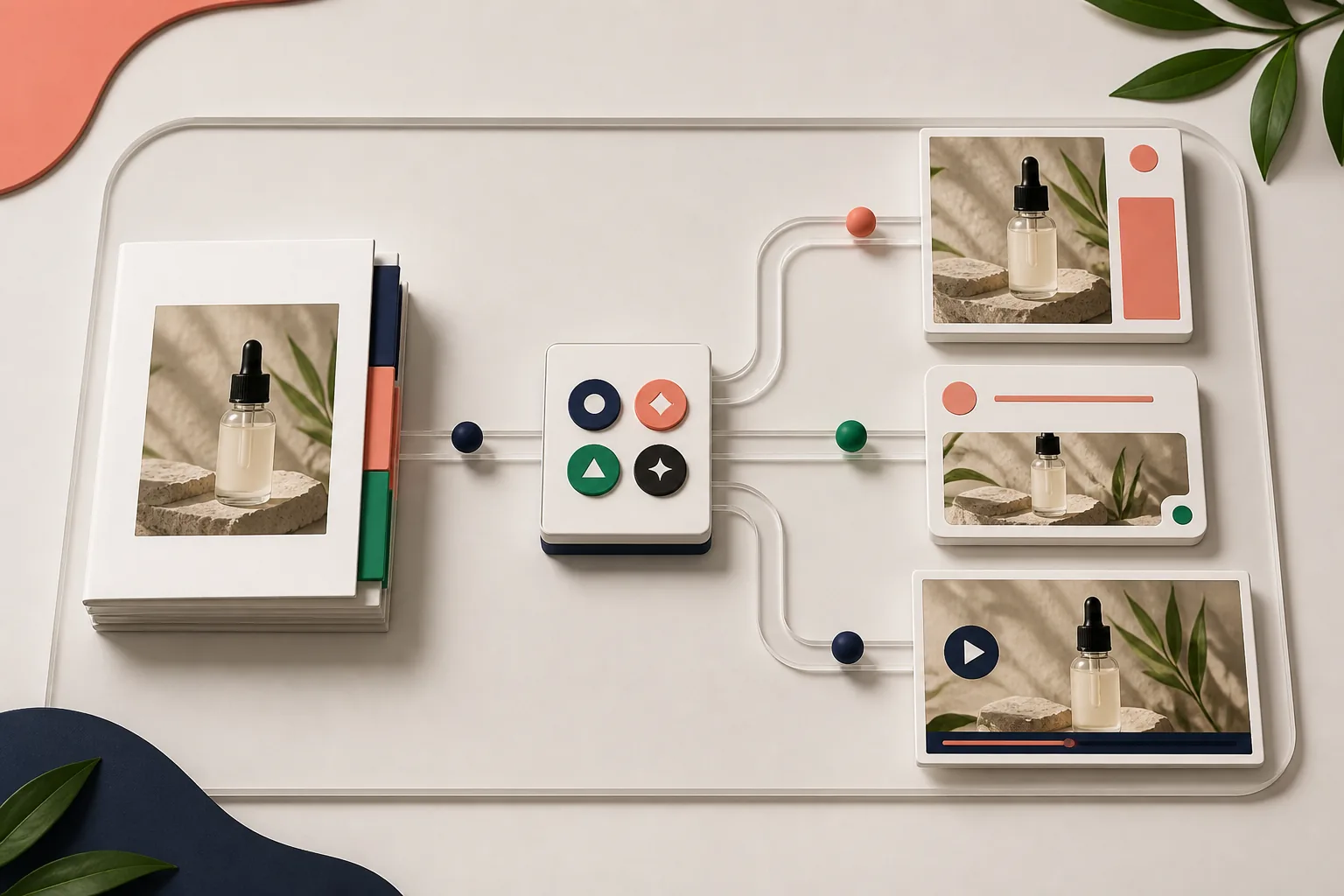
What good actually looks like
Brands that have closed the catalog-to-campaign gap tend to have restructured the operational side of growth in a specific way. Not by hiring more people. By treating catalog activation as a distinct discipline from performance marketing.
Every new SKU that launches has a default activation package — a specific set of creative assets, ad copies, feed metadata, WhatsApp launch message, and email inclusion — that is produced as part of the launch, not as a downstream task. The launch is not complete until the SKU is active on every channel where it belongs. The team's definition of "launched" changes from "listed on Shopify" to "listed and being shown to the market."
The catalog is audited monthly for coverage, not just performance. The question is not "which SKUs are performing" but "which SKUs are being given the input required to know whether they can perform." Products that have never been shown Meta creative do not appear in the retrospective as underperformers — they appear as untested inputs.
Creative production is operationally decoupled from campaign management. The team that produces the creative works on a batch cadence that covers a larger fraction of the catalog per cycle. The team that manages the campaigns focuses on which creatives to test against which audiences at what budget. The two jobs are related, not identical, and lumping them together is what creates the throughput ceiling.
Feed hygiene is a standing operational task, not a project. Someone on the team owns the Google Shopping feed and the Meta catalog feed as an ongoing responsibility, and metadata quality is measured. This alone often lifts performance across the long tail by 20-40% because the algorithms finally have a clean signal to work with.
Cross-sell and upsell logic is catalog-aware, not curated. Instead of the founder hand-picking three products to feature in post-purchase, the system routes to secondary products based on affinity data, product embeddings, and stock levels. This spreads discovery across the whole catalog automatically.
None of this requires a bigger team. It requires the team to be shaped differently — around catalog activation as a discipline, rather than around performance marketing as a monolith.
The four operating models Indian D2C teams typically try
Most brands cycle through some version of the following four models on their way to figuring out catalog activation. Each solves a specific pain and creates a specific new one. Knowing which model you are in — and which model you are about to move to — is more useful than the generic "we need better content" framing that usually accompanies the transition.
Pure agency retainer. The brand hires a full-service performance-marketing agency. The agency handles creative, media buying, reporting, and sometimes CRM. In the first six months this is the fastest way to get a functioning growth engine into market — the agency brings templated processes, a Meta rep relationship, and immediate creative capacity. The failure mode arrives at scale: the agency's creative bandwidth is spread across their client roster, so the brand's catalog-to-campaign coverage ceiling is whatever their assigned team can produce in a week, which is usually six to fifteen creatives across the whole client. When the brand grows past forty SKUs, the coverage gap widens visibly. The retainer keeps producing the same headline volume of creative regardless of catalog size, because agency margins depend on holding creative-hours per client roughly constant.
Full in-house team. The brand hires a growth head, two performance marketers, a designer, a copywriter, an editor, and sometimes a videographer. Fixed cost jumps to ₹18-30 lakh a month in salaries alone before tooling and boosted-spend budget. In exchange, catalog coverage improves — the team can produce twenty to forty creatives a week if disciplined. The failure mode is different: the team defaults to the flagship SKU because that is where the growth head's monthly KPI is measured, so the same catalog-to-campaign gap re-emerges inside the in-house team, just with the brand paying salary for it instead of retainer. Coordination overhead — who briefs, who approves, who publishes — starts eating a real fraction of throughput by month three.
Hybrid: in-house strategy + external production. The brand keeps a small in-house team responsible for brand voice, creative direction, and approval — usually a growth head, one performance marketer, and a copywriter — and contracts video production, edit, and design out to a specialised regional agency or a set of freelancers. This model works when the hybrid is clean: the in-house team writes the brief with catalog context attached, the external team returns platform-native creative, the in-house team approves. Coverage improves because production is not the bottleneck; the bottleneck moves to brief-writing and approval, which the in-house team can control. Failure mode is brief-quality drift — when the founder or growth head is busy, briefs get thinner, and the external team fills the gaps with generic creative that reads as off-brand.
Tooling-driven single-operator model. The brand runs its catalog activation through a small toolset (a scheduling calendar, a draft-assist tool, a media manager, an approval flow) with one operator inside the brand. The operator is not a specialist — often the founder or a generalist growth lead. Coverage scales with tooling quality rather than headcount. This model has become more viable in the last eighteen months because tooling that keeps catalog context attached to generated drafts, and enforces approval before publish, has matured enough for solo operators to run twenty to forty creatives a week without a team. Failure mode is tooling debt: when the operator changes tools mid-year, the audience and brand-voice memory built up in the previous tool does not transfer, and the flywheel resets.
A quick comparison of what each solves and what each breaks:
Open data table
| Model | Coverage ceiling | Fixed monthly cost | Best fit | Fails at |
|---|---|---|---|---|
| Pure agency retainer | ~6-15 creatives/week | ₹1-4L retainer | Early brand, small catalog (<20 SKUs) | Coverage does not scale with catalog size |
| Full in-house team | ~20-40/week if disciplined | ₹18-30L in salaries | ₹50-150 Cr GMV brand with capital | Flagship-SKU bias re-emerges inside the team |
| Hybrid in-house + external | ~15-30/week | ₹5-12L salaries + variable production | Growth-stage brand with strong brand voice | Brief quality drifts when founder is busy |
| Tooling-driven single-operator | ~20-40/week if tool is good | ₹1-3L tools + one salary | Founder-led brand, 20-80 SKU catalog | Tool switch resets accumulated memory |
None of the four is universally better. The point of naming them explicitly is that most brands cycle through them without noticing the transition, and each transition costs a quarter of growth momentum that could have been avoided by picking the next model deliberately instead of drifting into it.
The compounding cost of not closing the gap
The visible cost of the catalog-to-campaign gap is that the brand grows more slowly than it could. The invisible cost is more expensive.
Because most of the catalog is never marketed, the brand's understanding of its own product-market fit is skewed. The team believes the flagship is the flagship because the market has decided so. In many cases the flagship is the flagship because it is the only product the market was ever shown. This is a subtle error that shapes every future roadmap decision.
Because inventory ages on secondary products, working capital gets tied up in slow-moving stock. The founder becomes more conservative about SKU proliferation, launches fewer new products, and slows the innovation cadence. The brand becomes narrower over time, not broader.
Because the retargeting audiences and lookalike models are trained on flagship engagement, the paid media flywheel becomes brittle. When the flagship's performance dips — which happens seasonally, competitively, or during product fatigue — the brand has no secondary product with its own trained audience to lean on. The whole account underperforms during flagship transitions in a way that would not happen if the catalog had breadth of live campaigns.
Across three years, these compounding costs — narrowed product understanding, tied-up working capital, brittle paid media — often add up to a valuation impact at fundraising that founders learn about only when they are pitching investors who ask specifically about revenue diversity.
Signals your catalog-to-campaign flow is broken
A short diagnostic. If four or more are true, most of your catalog is dark to paid media and you are amplifying a fraction of what you built.
- Fewer than one in five SKUs has active creative running in Meta this week.
- The same three or four hero SKUs account for over eighty percent of ad spend.
- Google Shopping feed has stale prices, missing GTINs, or product titles that do not match live catalog copy.
- WhatsApp broadcasts only reach subscribers of the flagship SKU — secondary products have no independent audience list.
- Content team asks growth team what to shoot, growth team asks content team what is ready — the loop stalls.
- New SKU launch takes six weeks from PDP-live to first paid creative in market.
- Regional creative for the flagship exists in one language, not the four the audience actually watches in.
- Retargeting audiences and lookalikes are trained almost entirely on flagship engagement, so a flagship dip drags the whole account down.
- Working capital sits in secondary SKUs that have inventory but no live campaign feeding them buyers.
The operator's takeaway
If you are running growth or marketing at an Indian D2C brand of any scale, the honest test is this. Open your Meta ads manager and count the active creatives running this week. Count the SKUs in your Shopify catalog. Divide.
If the ratio is below twenty percent — meaning fewer than one in five of your products has any active creative — you have quantified the catalog-to-campaign gap. It is not a marketing failure. It is an operational structure that is producing the outcome you would predict. The intervention is not more budget. It is to redesign the catalog activation flow so that the team's throughput matches the shape of the catalog, not the shape of the flagship.
The brands that solve this quietly outperform the brands that solve every other growth question loudly. Because the catalog is the growth surface. Everything else is amplification. If most of the surface is dark, you are amplifying a fraction of what you built.
The catalog is your growth engine. Most brands run it at a fraction of its capacity, not because they lack ambition, but because nobody named the operational gap. Named, it is solvable. Unnamed, it compounds against you every quarter.
Where Top Notchh fits
This is a Studio field note — the pattern shows up on our radar because it is exactly the operational shape a product we are researching (working name Omnipost Max) is aimed at. Not marketed yet. If your team is stuck at the throughput ceiling this post describes and you want to compare notes as an early design partner, reach out.
If bundling — the other growth lever most Indian D2C brands underrun — is your problem instead, Wolfpack Bundle Builder, BYOB is the shipped product on that surface. For more field notes from adjacent surfaces, read the other Studio pieces.\n
Evidence ledger
Sources and verification
- DataKart: A national repository of product dataGS1 India · reference · checked Sep 1, 2026
- Product data specificationGoogle Merchant Center Help · normative · checked Sep 1, 2026