Journal
Studio · Field note
Aug 4, 2026
11 min read
By Top Notchh Team
Reviewed Sep 1, 2026
Sources: research supported
The sixty-second window in Indian residential real estate
A measurement-first field note on speed-to-lead, consent, handoffs, and testing a fast-response SLA without inventing Indian conversion benchmarks.
In brief
- Sixty seconds is a testable operating SLA, not a universal India-specific conversion law.
- Measure response-time bands against connection and site-visit outcomes before automating policy.
- Fast follow-up still requires valid consent, registered commercial-communication practices, and clear ownership.
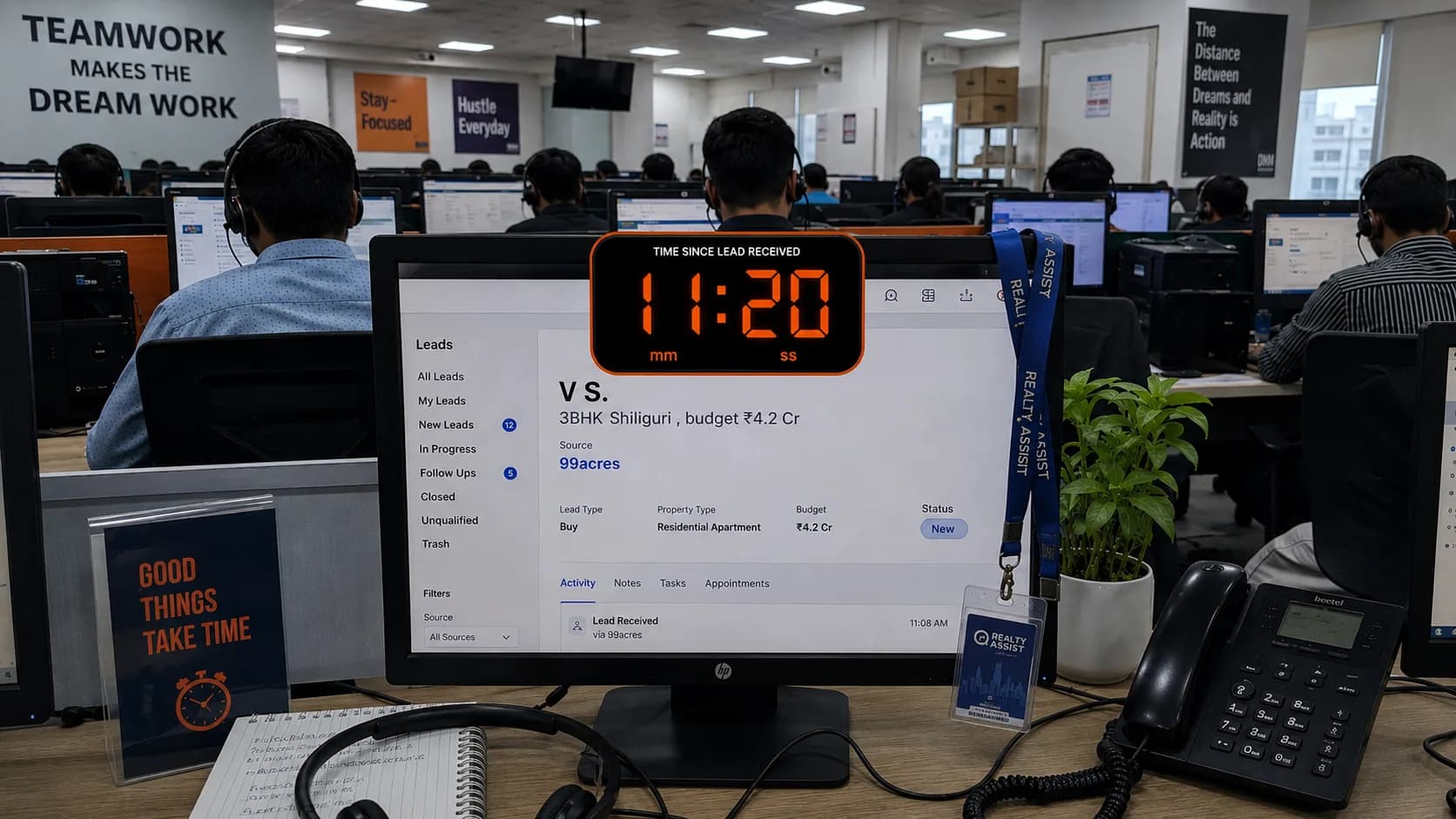
\n\nThere is a specific moment in the life of a residential real estate lead in India where the sale is either kept alive or quietly lost, and it is not the site visit. It is not the negotiation. It is not the follow-up call that never happens after the site visit. It is the first sixty seconds after a person clicks "Get in touch" on 99acres or MagicBricks or Housing.com or the developer's own landing page. Whatever happens in that window decides whether the enquiry becomes a site visit at all.
Most teams selling premium apartments in Mumbai, Bangalore, Pune, Gurgaon, Hyderabad know intellectually that response time matters. Almost none of them treat it as an operational discipline. The gap between what they believe about their response time and what actually happens in production is usually where the bulk of their portal spend leaks out.
What the enquiry actually is
The enquiry that arrives at four in the afternoon on a Wednesday is not a database row waiting patiently. It is a decision that has just been made — briefly, tentatively, by a person who has been scrolling through six other listings, has a job to get back to, and has a spouse or parent about to call about something else. The interest is real. The attention is fragile.
Whoever calls that person in the next sixty seconds, while the tab is still open and the mental picture of the apartment is still loaded, has a real conversation. Whoever calls two hours later has a cold call. The two experiences look identical in the CRM. They are not the same conversation.
This is the whole game, and it holds true whether the apartment is worth ₹80 lakh or ₹8 crore. Buyers of ₹8 crore apartments do not, in the moment they submit a lead, feel different from buyers of ₹80 lakh apartments. They feel curious. That curiosity is fragile in exactly the same way.
Where the leak actually happens
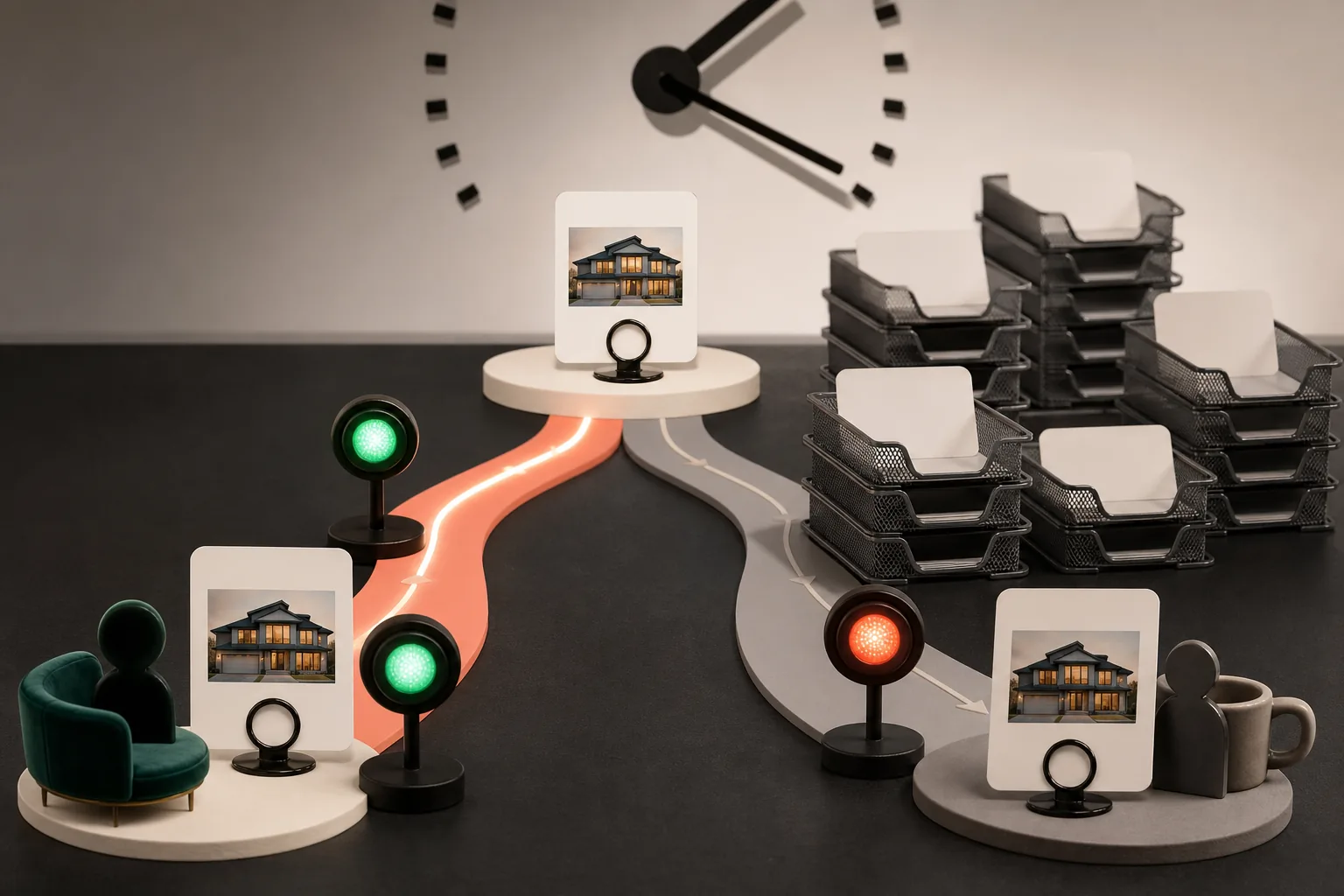
The typical Indian residential first-touch flow looks like this. The portal lead arrives at a shared CRM or an aggregator dashboard. A telecalling team — usually a Knowlarity or Exotel-integrated BPO, sometimes in-house, often a mix — picks it up from a queue. The first call happens somewhere between forty minutes and four hours later, depending on time of day and team load. If the call connects, a standardised qualification script runs — budget, timeline, configuration preference, financing status. If the buyer sounds serious, they are handed to a channel partner or a developer sales manager for the site visit. If not, they enter a nurture pool that most teams do not work seriously.
Every step in that flow is sensible in isolation. The composite is expensive.
The specific failure modes:
-
The queue itself is the delay. The lead sits in a shared inbox waiting for the next available agent. On a Wednesday afternoon in Mumbai, the queue depth is usually forty to a hundred deep across active projects. The lead is not being ignored — it is being processed at whatever rate the team's capacity allows, which is not the rate at which the buyer's curiosity is decaying.
-
The first call is a qualification, not a conversation. The telecaller is trained to run a script. The buyer, who is at a desk between two meetings, cannot answer twenty structured questions. The buyer says "call me later" and does not answer when the callback comes.
-
The handoff to the channel partner is a hand-me-down. The channel partner receives a CRM note with the qualification script results and no context. The site visit conversation opens with the same questions the telecaller already asked. The buyer is fatigued by the third repetition.
-
WhatsApp is where the actual buying conversation happens, and no one owns it. The buyer, if they liked the first call, will send a WhatsApp asking for the floor plan or the price sheet. That message often lands with a different person than the one who took the first call. The context is lost. The buyer resends the message. If the second message goes unanswered for six hours, the conversation is over.
-
The after-hours enquiry is nobody's problem. A lead landing at nine in the evening in the pre-launch phase of a project is one of the highest-intent signals a developer receives. Almost no team has an after-hours protocol. That lead gets called the next morning, at which point the buyer has already spoken to two other developers.
None of these are lazy people. They are the natural output of a system that treats lead-response as a task queue rather than as a race that was already running before the CRM row was created.
The unit economics of a five-minute delay
The reason first-touch time is usually undervalued is that the cost of a delay is not visible in the CRM. The CRM shows the lead as "contacted" — whether the contact happened in ninety seconds or ninety minutes. The downstream cost sits inside two numbers most sales heads track but rarely correlate to response time: the site-visit rate and the enquiry-to-booking ratio.
Consider a typical mid-scale Indian residential project. The developer or channel partner is paying somewhere between ₹800 and ₹2,500 per qualified portal enquiry across 99acres, MagicBricks, Housing.com, and paid Meta lead-gen combined, depending on the city, ticket size, and season. A single month of active portal spend on a launched project generates anywhere from 400 to 1,500 raw enquiries. Of those, historically, roughly 30-40% will end up marked as "contacted" but never actually convert to a site visit. Another 20-25% will convert to a site visit but never come back for a second one. The visible funnel loss is enormous, and the standard explanation is "poor lead quality from the portal."
That explanation is partially true and largely convenient. A meaningful fraction of the loss is not lead quality — it is response latency. Research on inbound sales response time in North American B2C funnels has been consistent for over a decade: the probability of a substantive first conversation with an enquirer drops by more than half when the first contact attempt shifts from under one minute to over five minutes, and drops by an order of magnitude when it shifts from under one minute to over one hour. Indian residential real estate has no reason to be different — if anything, the effect is stronger because Indian buyers scroll more listings per session and their attention window per enquiry is narrower.
Do the math against a specific project. Assume ₹1,500 per portal enquiry, 800 enquiries a month, so ₹12 lakh in monthly portal spend. If 10% of the ₹12 lakh is being spent on leads that never got a real first conversation because the callback came ninety minutes late, that is ₹1.2 lakh a month in wasted media, before counting the downstream site-visit and booking loss. Over a launch window of six to nine months for a mid-scale project, the compounded cost of a slow first-touch operation on a single project routinely runs into tens of lakhs — money the developer already spent and is not converting.
The site-visit sales team never sees this cost because it presents as "fewer good leads this month," not as "the leads we bought went cold before we called them." The portal never sees this cost because the leads were technically delivered. The only place the cost is visible is in a manual sample of median first-touch times against the same month's site-visit rate — a correlation almost nobody runs.
Why premium changes the timing but not the shape
There is a temptation, in the premium segment, to argue that speed matters less because these buyers are considered. They will take three months to decide. They are comparing five projects. They are not going to close in the first week.
This misreads the data. The buyer will take three months to close. But the shortlist — the two or three projects they seriously consider — is being built inside the first ten days. The rest of the three months is elimination between projects on the shortlist. If your project did not make the shortlist because your first call happened four hours after the enquiry and the buyer had already spoken to two competitors, you are not in the negotiation at all. You are in the "we'll come back to you" pile that never gets revisited.
The three-month closing cycle in premium residential is not evidence that speed does not matter. It is evidence that speed matters earlier than most teams believe, at the moment the shortlist is forming, not the moment the deposit is discussed.
What good actually looks like
The developers and channel partners quietly outperforming their portal spend tend to have a specific set of practices that most teams do not.
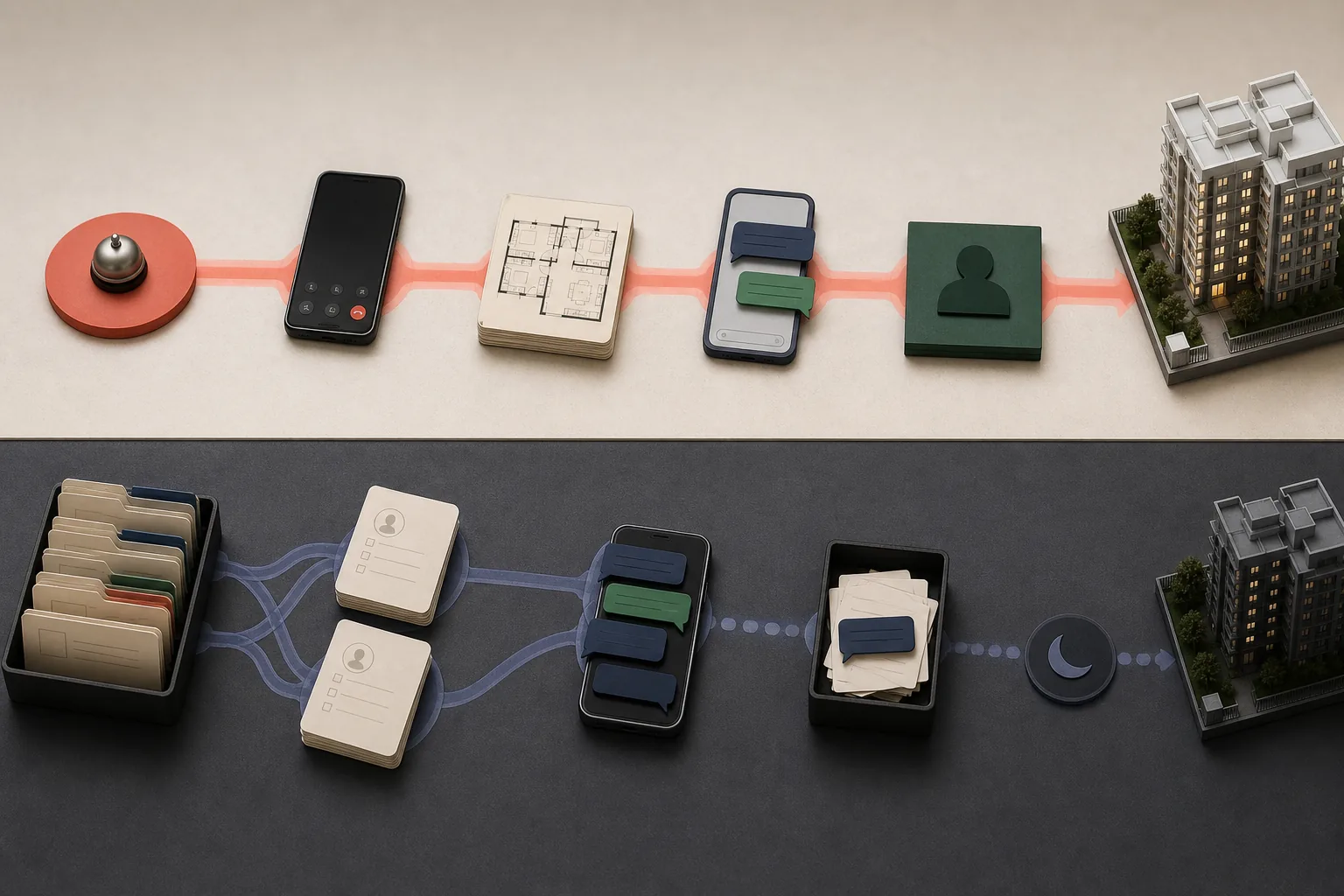
The first call happens within one minute of the enquiry, not because a human is faster, but because the trigger is automatic. The lead lands, the call goes out. The buyer either picks up in that window (highest-value conversation of the funnel) or the system leaves a specific voicemail and follows up on WhatsApp within another two minutes. Either way, the buyer's phone lights up while their attention is still with the apartment.
The first call is short. It is not a twenty-question script. It is a three-line opener — who you are, what project, offer the floor plan on WhatsApp, ask one qualifying question. The buyer stays on the line for ninety seconds because ninety seconds is what they can spare between meetings.
WhatsApp is treated as the primary channel after the first call, not the recording. The floor plan, the price sheet, the location video are pushed within five minutes of the first call while the buyer is still forming their impression. Every subsequent message from the buyer routes to a named person who has the full context.
The after-hours protocol is defined in advance. Sometimes an AI-assisted first-touch. Sometimes a smaller after-hours team with narrower authority. Never nothing.
The handoff to the site-visit-owner is a structured artifact — one screen, one page — that the site-visit sales manager can absorb in ninety seconds. Not a call recording, not a freeform note. The buyer's job-to-be-done in one sentence, three qualified facts, the next specific action, one thing that would surprise the next person.
None of this is glamorous. It is not the part of real estate sales that ends up in books. It is the part that decides which developer's project makes the buyer's shortlist and which one gets remembered as "the one that called four hours later, when I had already moved on."
The compounding cost
Once a developer or a channel partner starts measuring speed-to-lead honestly, they usually find that the cost is worse than they thought. The lost enquiries are the visible cost. The invisible cost is the reputation.
Premium buyers talk to each other. A friend who says "I filled the Godrej form and someone called me back in twenty seconds and had the floor plan on WhatsApp in three minutes" tells that story. A friend who says "I filled a form and got a call the next afternoon" also tells that story. In premium residential, where a large fraction of enquiries come from social referrals inside a compact urban network, the reputation compounds visibly across a project's launch window.
A team that responds fast starts to accumulate a reputation for being serious. A team that responds slow accumulates a reputation for being casual, which in premium residential is fatal because the buyer reads casual as a signal about how the project itself will be delivered.
Every leak in the first-minute window is not one lost lead. It is one lost lead plus a compounding tax on the next twelve enquiries that would have come through the same social graph.
Signals your first-touch is leaking
A short diagnostic. If four or more of these are true, the sixty-second window is where your portal spend is being spent.
- Median first-touch time — sampled by hand from twenty random leads this week — sits above five minutes.
- The first call is a qualification script, not a conversation. Buyers stay on for under sixty seconds before asking for a callback.
- The first WhatsApp follow-up lands more than fifteen minutes after the enquiry, or lands from a different number than the caller.
- Floor plans and price sheets are shared on request rather than pushed within five minutes of the first call.
- After-hours enquiries — between 8 PM and 9 AM — get their first response the next morning.
- The handoff from telecaller to channel partner or site-visit manager is a call recording or freeform note, not a one-screen structured summary.
- Nobody on the team can answer "what percentage of enquiries got a call inside two minutes this week" without opening a spreadsheet.
- Channel partners repeatedly ask the buyer the same qualifying questions the telecaller already asked.
The operator's takeaway
If you are running a residential sales function of any kind — for a developer, a channel partner, a portal aggregator — the honest test is not whether you believe in speed-to-lead. It is whether you have measured your median first-touch time this week. Not the average. The median. Not the reported number from the CRM. The actual number, sampled by hand from a random twenty enquiries.
If that number is above five minutes, the intervention that pays for itself fastest is not a better landing page, not a bigger telecalling team, not a new CRM. It is a structural change to the first-minute path that removes every human decision from it.
The teams that do this quietly outperform the teams that do everything else loudly. Because the compounding effect of a fast first touch is a real number, not a slogan, and in Indian residential real estate — where portal spend is the single largest marketing cost most developers carry — closing the first-minute gap is the largest ROI intervention available that does not require selling a single additional apartment.
The first sixty seconds are not a marketing moment. They are the shortlist decision. Everything else in the three-month cycle is confirmation.
Where Top Notchh fits
This is a Studio field note — the pattern lives on our radar because it maps to the operational problem a product we are researching (working name RealClose AI) is aimed at. Design-partner discovery only right now, no marketing claims. If you run residential sales for a developer or channel partner and this window is leaking for your team, reach out and we can compare notes.
For more field notes from adjacent operational surfaces, read the other Studio pieces.\n
Evidence ledger
Sources and verification
- The Short Life of Online Sales LeadsHarvard Business Review · research · checked Sep 1, 2026
- Telecom Commercial Communication Customer Preference RegulationTelecom Regulatory Authority of India · normative · checked Sep 1, 2026